Saturday, August 18, 2007

Low key and soft values on a rainy Saturday

Light and dark. Aspects of painting and life itself; values get a lot of discussion in both art and life as well. Well, I need plenty of good lighting in my studio today, as the rain falls and clouds keep the sun cloistered. The colors in the land and sky are soft and the values are darker. I'm not keen to go out and paint in weather like this! I admire those who do. Rain water running up my coat sleeve just isn't appealing in spite of how pretty and soft everything looks in this weather.

As I think about the creative goals I have this summer I invite you to think back on what you decided to accomplish in your creative life over the summer months. How's that going for you? Are your nurturing the things you truly value? We make our plans, god willing and the creek don't rise. We can all be waylaid by all that life brings along which we didn't plan so, all that aside, have you made steps toward your creative goals? Have you set down some goals with clarity which you feel are probably essential as you move towards your big goals and dreams? Have you deliberately and courageously named two or three supporters who you trust and believe will be open-minded, positive and able to support your work towards your goals and dreams? Have you asked for their support? Have you written to the galleries that handle work like yours? There's a lot of work that gets done behind the scenes. It's as important as our hands-on creative work.

I hope you feel pleased with the progress you're making. It's easy to belittle the progress we make. Somehow, we rewrite history so tasks look bigger when they're ahead and smaller when they're in the past! I hope you're being reasonably patient with yourself and others. All great artists trip over their feet from time to time, not to mention all the other debris there is to trip on on the Highway of Life. Persistence with a good dollop of kindness wins the day. Focus on working from love not fear, and keep moving forward. Celebrate every accomplishment, small and large - your own and those of people you care about. And help each other have fun along the way!

Now, where did I put my summer 'to do' list?

Friday, April 20, 2007

Ten Seconds for Art, Heart, Anxiety and PTSD

Today I'm excited to share an interview with one of my favorite people, Dr. Eric Maisel , respected author and internationally recognized expert on creativity. His new book called Ten Zen Seconds describes a centering technique which takes just a few seconds to implement. Occasionally we leaern about a technique or tool which can last a lifetime, supporting and enriching our growth through the triumphs and tragedies of life, and the most precious are usually simple, elegant and powerful. I believe this centering technique is definitely in that realm. Eric's book includes wonderful personal anecdotes from lots of folks using this technique in many different situations. There's lots of room for awe and self-discovery. I've been waiting to ask Eric if this centering technique could alleviate or heal symptoms of severe anxiety and post traumatic stress disorder (PTSD), too.

Pamela Yates: Hi Eric! I'm so glad you could join us today.

Eric Maisel: Thanks for having me!

PY: What is Ten Zen Seconds all about? Can you give us a thumbnail sketch?

EM: It’s actually a very simple but powerful technique for reducing your stress, getting yourself centered, and reminding yourself about how you want to live your life. It can even serve as a complete cognitive, emotional, and existential self-help program built on the single idea of “dropping a useful thought into a deep breath.”

PY: How does the technique work?

EM: You use a deep breath, five seconds on the inhale and five seconds on the exhale, as a container for important thoughts that aim you in the right direction in life—I describe twelve of these thoughts in the book—and you begin to employ this breathing-and-thinking technique that I call incanting as the primary way to keep yourself on track.

PY: Where did this idea come from and how did your background contribute?

EM: It comes from two primary sources, cognitive and positive psychology from the West and breath awareness and mindfulness techniques from the East. I’d been working with creative and performing artists for more than twenty years as a therapist and creativity coach and wanted to find a quick, simple technique that would help them deal with the challenges they regularly face—resistance to creating, performance anxiety, negative self-talk about a lack of talent or a lack of connections, stress over a boring day job or competing in the art marketplace, and so on.

Because I have a background in both Western and Eastern ideas, it began to dawn on me that deep breathing, which is one of the best ways to reduce stress and alter thinking, could be used as a cognitive tool if I found just the right phrases to accompany the deep breathing. This started me on a hunt for the most effective phrases that I could find and eventually I landed on twelve of them that I called incantations, each of which serves a different and important purpose.

PY: How did you decide on the important ideas or phrases you selected?

EM: First, I tried to figure out what are the most important tasks that we face as human beings, then I came up with what I hoped were resonant phrases, each of which needed to fit well into a deep breath, then, most importantly—which moved this from the theoretical to the empirical—I tested the phrases out on hundreds of folks who agreed to use them and report back on their experiences. That was great fun and eye-opening!

People used these phrases to center themselves before a dental appointment or surgery, to get ready to have a difficult conversation with a teenage child, to bring joy back to their performing career, to carve out time for creative work in an over-busy day—in hundreds of ways that I couldn’t have anticipated. I think that’s what makes the book rich and special: that, as useful as the method and the incantations are, hearing from real people about how they’ve used them “seals the deal.” I’m not much of a fan of self-help books that come entirely from the author’s head; this one has been tested in the crucible of reality.

PY: Which phrases did you settle on?

EM: The following twelve. I think that folks will intuitively get the point of each one (though some of the incantations, like “I expect nothing,” tend to need a little explaining). Naturally each incantation is explained in detail in the book and there are lots of personal reports, so readers get a good sense of how different people interpret and make use of the incantations. Here are the twelve (the parentheses show how the phrase gets “divided up” between the inhale and the exhale:

1. (I am completely) (stopping)
2. (I expect) (nothing)
3. (I am) (doing my work)
4. (I trust) (my resources)
5. (I feel) (supported)
6. (I embrace) (this moment)
7. (I am free) (of the past)
8. (I make) (my meaning)
9. (I am open) (to joy)
10. (I am equal) (to this challenge)
11. (I am) (taking action)
12. (I return) (with strength)

A small note: the third incantation functions differently from the other eleven, in that you name something specific each time you use it, for example “I am writing my novel” or “I am paying the bills.” This helps you bring mindful awareness to each of your activities throughout the day.

PY: Can you use the incantations and this method for any special purposes?

EM: As I mentioned, folks are coming up with all kinds of special uses. One that I especially like is the idea of “book-ending” a period of work, say your morning writing stint or painting stint, by using “I am completely stopping” to ready yourself, center yourself, and stop your mind chatter, and then using “I return with strength” when you’re done so that you return to “the rest of life” with energy and power. Usually we aren’t this mindful in demarcating our activities—and life feels very different when we do.

PY: I wonder how your techniques might apply specifically to visual artists?

EM: There is one special way: because we have so much visual data in our lives already, almost to the point of visual assault, it can prove hard for a visual artist to feel like it is meaningful to add “more visual data” into a universe already replete with imagery. This is a “meaning problem,” that is, an existential problem, which can rise to the level of meaning crisis, precipitated by the doubt that more imagery—or more imagery of a certain sort, like landscape or portrait—is still meaningful to produce.

This is where incantation 8, “I make my meaning,” can prove really useful. When an artist reminds herself that she is the sole arbiter of meaning in her life and that she can “stand behind” her decision to produce her particular imagery just by deciding to take that stand, she shores up any meaning leaks and can get on with her work. The combination of incantation 8, “I make my meaning,” and incantation 10, “I am equal to this challenge,” an incantation that acknowledges how challenging visual representation can be, is a powerful combination in a visual artist’s “cognitive toolbox.”

PY: Eric, this is a question close to my heart. How can sufferers of PTSD and other severe anxiety disorders who want to lessen or even eliminate their prescription medications make use of your Ten Zen Seconds methods?

EM: It can be terribly hard for sufferers of severe anxiety disorders to handle their anxiety without medication. One of the important shifts for anxiety sufferers whose anxiety is related to specific traumas, as is the case with those who suffer from post-traumatic stress disorder, is arriving at a place of remembering the trauma without having to relive the trauma. That is, you want to be able to have a certain kind of thought (a memory) without having a certain kind of feeling (a whole-body experience of the trauma happening again).

Therefore you can use the name-you-work incantation, incantation 3, to name as your work “I can remember without re-experiencing,” “I can remembering without reliving,” or some similar phrase that, coupled with the healing power of a deep breath, starts to separate the memory from the emotional charge, so that you don’t have to live in fear of your own memory. Coupling this incantation with “I feel supported” and/or “I am free of the past” produces a short, half-minute-long personalized centering mantra that targets the effects of PSTD.

PY: Is there a way to experience this process in “real time.”

EM: By trying it out! But my web master Ron Wheatley has also designed a slide show at the Ten Zen Seconds site (http://www.tenzenseconds.com) that you can use to learn and experience the incantations. The slides that name the twelve incantations are beautiful images provided by the painter Ruth Yasharpour and each slide stays in place for ten seconds. So you can attune your breathing to the slide and really practice the method. The slide show is available at http://www.tenzenseconds.com/test_photo_slide.html

PY: How can people learn more about Ten Zen Seconds?

EM: The book is the best resource. You can get it at Amazon by visiting:

http://www.amazon.com/Ten-Zen-Seconds-Eric-Maisel/dp/1402208537/sr=1-25/qid=1167239458/ref=sr_1_25/102-5337867-2282549?ie=UTF8&s=books

Or you can ask for it at your local bookstore. The Ten Zen Seconds website is also an excellent resource: in addition to the slide show that I mentioned, there is a bulletin board where folks can chat, audio interviews that I’ve done discussing the Ten Zen Second techniques, and more. It’s also quite a gorgeous site, so you may want to visit it just for the aesthetic experience! I would also recommend that folks check out my main site, http://www.ericmaisel.com, especially if they’re interested in creativity coaching or the artist’s life.

PY: I know you're always engaged in new creative work so please tell us what else are you up to?

Plenty! I have a new book out called Creativity for Life, which is roughly my fifteenth book in the creativity field and which people seem to like a lot. I also have a third new book out, in addition to Ten Zen Seconds and Creativity for Life, called Everyday You, which is a beautiful coffee table book about maintaining daily mindfulness. I’m working on two books for 2008, one called A Writer’s Space and a second called Creative Recovery, about using your innate creativity to help in recovering from addiction.

And I’m keep up with the many other things I do: my monthly column for Art Calendar Magazine, my regular segment for Art of the Song Creativity Radio, the trainings that I offer in creativity coaching, and my work with individual clients. I am happily busy! But my main focus for the year is on getting the word out about Ten Zen Seconds, because I really believe that it’s something special.

PY: Eric, it's been so good having you join us here at the Creative Circle Cafe. We'd love to have you back again any time you feel like chatting with us again. Thank you.

EM: Thank you for having me here today!

****
Eric Maisel, Ph.D., is the author of more than thirty books. He holds Bachelor’s degrees in Philosophy and Psychology, Master's degrees in Creative Writing and Counseling, and a Doctorate in Counseling Psychology. He is a California licensed marriage and family therapist, a creativity coach and trainer of creativity coaches, a columnist for Art Calendar Magazine, provides regular segments for Art of the Song Creativity Radio, and teaches Ten Zen Second techniques through lectures, workshops, and teleseminars. He lives in San Francisco.

Dr. Maisel is widely regarded as America's foremost creativity coach and has taught thousands of creative and performing artists how to incorporate Ten Zen Second mindfulness techniques into their creativity practice.
****

Sunday, April 15, 2007

Hope for people experiencing anxiety and PTSD

Today was a day of filing and desk work in my studio and as I tidied my studio desk and drawing area I was thoughtful about the questions I will be asking Dr. Eric Maisel during my interview with him next Friday when we discuss his new book, Ten Zen Seconds. Eric Maisel is a thoughtful, creative and helpful expert in the area of creativity and he's been engaged in this work for more than two decades. His style of helpful, compassionate insight and motivation has empowered many people in a good way - including those called to do creative work as painters, writers, musicians, sculptors, weavers, potters, playwrights, you name it. His books, workshops, talks, web and blog provide creative and inspiring resources for just about anyone.

I was invited to choose a focus area for the interview - a question or two in an area of special interest. I'm interested in how the centering technique in Eric's new book Ten Zen Seconds can be applied to alleviate or eliminate symptoms of anxiety and post traumatic stress. And, along with a thoughtful and careful approach with a medical professional if you're taking prescription medication, possibly even allow some folks to re-evaluate how they treat the condition. Clearly that's not the goal of the centering technique. I've experienced the symptoms of severe anxiety and PTSD, and having experienced a great amount of healing I know that even small positive changes can feel immensely empowering and hopeful. When I share my stories I'm always surprised by the incredible number of women and men challenged by these conditions.

I've been aware of Eric Maisel's work as a creativity expert for many years and I'm very excited to share this interview with you. I hope one or many of you will find a way to experience reduced symptoms or a new freedom from anxiety or PTSD. Anything is possible.

Drop in again on Friday, April 20, to catch that interview with Eric.


The Eagle feather reminds us to strive towards wisdom and courage, one day at a time.

Sunday, April 8, 2007

The Fragrance of the Earth

There's a morning each Spring when I awake and as I'm just coming awake, thinking or saying a morning prayer, going about my usual morning habits and human rituals I'll become aware of the unfrozen Earth in a special way. It's more unconscious than conscious to begin with, a sense that I'm noticing something just outside my field of vision. Sure, I might have noticed the ground beginning to soften a bit beneath my feet or noticed less chill in the air but what is especially precious is the moment when my body senses the fragrance of the Earth. I've talked about this to my friends and we marvel at the tantalizing and startling awareness and senses we have within ourselves. There's a deeply resonant connection that is remade each year at this time. It is now that the first Thunder comes to wake the plants and trees. And us. Mother Earth and the Grandfathers and Grandmothers awake us to Spring time!

What does this mean? What can it mean to creative people? Every person finds their own answers. I believe it's important and helpful to find some answer which connects us to these powers and presences in Creation. So I wish you a good journey this Spring, listening and learning as I myself will be trying as best I can to slow down and experience the Oneness, smelling the fragrance of the Earth newly melted and moist finally, after the cold and ice. Earth's fragrance as our living Mother and Grandmother in the Circle of Life, nurturing us as we rediscover our natural place on the Hoop.

In arid lands like the area where I was born there is a special sacred smell that comes when rain comes to the dry Earth. I know my life moves too fast at times and I'm so busy that I often miss these fragrances. They can be a reminder to me to slow down, to remember what I notice when I'm attentive to Creation and the Hoop of life, all around us, all the time. As creative people we can find peace and good energy from balancing our senses and being attentive to the Dance.

On Friday, April 20 I will have the pleasure of interviewing Dr. Eric Maisel about his new book, Ten Zen Seconds. I've seen a pre-publishing copy and I feel absolutely sure that many of us will blossom and expand our creative energy and creative productivity from the practice he's going to teach us about. I can't wait! The focus for part of my conversation with Eric will be how practice of Ten Zen Seconds can help people who are challenged by issues of PTSD, severe anxiety and recovery from addiction. These are serious, challenging and important topics - it is Spring, the time of Mother Earth's re-awaking and renewal and it is the perfect time for this discussion!

Enjoy the fragrance of the Earth!

Sunday, March 25, 2007

Audacious balance, creativity and Ten Zen Seconds

If we look around we'll find there's a whole bunch of successful, producing artists who maintain a healthy balance of tender-hearted compassion and resilient toughness. They've learned to keep their hearts open to the mystery while recognizing and letting go of apathy and materialism.

Artists and others can decide to learn and practice this sort of healthy balance, first, by being aware it's possible and then by learning about and modeling the behavior - using awareness, practice, patience and maturity. There's lots of thoughtful books and guides about how to practice letting go, becoming mature people, honoring the sacred self and some suggested reading is included below. A great new book just released by author Dr. Eric Maisel called Ten Zen Seconds provides guidance on how to increase your sense of balance by following a simple, effective method of mindfulness practice. I'm excited by the opportunity to interview Eric Maisel about his new book on Friday, April 20. We'll chat about the methods described in his new book and the benefits specifically for artists and other creative people. I'll be asking questions about this practice can benefit my clients with the issues they frequently deal with in their creative work. Until now, no one has married the best of Eastern and Western thought into a simple technique that produces breakthrough results with only a few seconds’ effort. I invite you to check back with us for that interview on Friday, April 20.

Audacious balance allows artists to commit to big, audacious dreams and goals that are meaningful to them without feeling overly exposed, vulnerable or emotionally adrift. Balance provides safety in the sometimes harsh world of the arts and arts criticism. Maintaining healthy balance requires a sense of community. Community is vital for most of us. We are tribal people, all of us. Even in times when we're isolated or alone for a time, a person can hold within themselves a strong sense of community. Communities are extended family and friends, neighbors, patrons, specialized communities for the arts, as well as authentic virtual communities via the internet. The measure of a supportive community is its ability to offer the artist compassion, acceptance and respect for the artist and her work. If an artist doesn't feel part of a supportive community, deciding to find a meaningful one is a worthwhile goal. It's not so important how often the connection is made in the external physical world, as it is to feel strongly connected. Another measure of community is the self-trust it nurtures for the artist in her or his creative work.

Two complex steps in the process of building healthy balance are, first, to decide that compassion and justice matter and, second, that you and your creative work matter. Sounds simple enough, doesn't it? Applying healthy balance means being able to handle success and rejection while continuing to nurture and develop your creative work with focus and clarity. Healthy balance allows the artist to observe the changing whims of buyers and the marketplace while feeling in charge of deciding to allow or disallow these things to influence their creative work.

Artists are the carriers of important dreams for all people. Artists want to share their creative work because it's natural to want to share the special gift given to each one of by the Creator. So, it's only natural to honor our audacious dreams, give voice to mighty goals while maintaining a soft, gentle and protective watch over ourselves as we walk our creative path. We will stumble because we are human but hopefully we get refreshed and re-choose to embrace and celebrate the creative process. Artists hold a special place in society. They are the storytellers, visionaries, historians, prophets. They can choose to see with the eyes of the heart even though the depth of that vision can be challenging because they'll feel and sense things in ways other people don't.

The challenge for the artist is to honor all this while remaining humble and awed by the starlight which illuminates our path.

*****

A word about the suggested reading list. If a book appears to be directed to a specific target group, please try to ignore that fact because each of these books can offer something important. Creative people of all ages and backgrounds often say that they doubt themselves, their creative work, their wisdom and perceptions. I hope the books listed here bring you strong, affirming teachings written in many different ways to bring good things to many people. Have fun - be curious - enjoy!

(1) Ten Zen Seconds by Dr. Eric Maisel
(2) Fearless Creating by Dr. Eric Maisel
(3) The Sacred Tree - Reflections on Native American Spirituality published in Canada by Four Worlds Development Press, Four Worlds Development Project, University of Lethbridge; in the USA by Lotus Light, Wilmot, Wisconsin. (ISBN 0-941524-58-2 Library of Congress #89-63193)
(4) The Lakota Way, Stories and Lessons for Living by Joseph M. Marshall III.
(5) No Word For Time, The Way of the Algonquin People by Evan T. Pritchard.
(6) The Compassionate Rebel, interviews and stories written and compiled by Burt F. Berlowe, Rebecca A. Janke, and Julie D. Penshorn. Growing Communities for Peace. web: www.peacemaker.org.
(7) Alcoholics Anonymous by Alcoholics Anonymous World Services, Inc.
(8) 12 Steps to Self-Parenting for Adult Children of Alcoholics by Philip Oliver-Diaz and Patricia A. O'Gorman.
(9) Wounded Warriors - A Time For Healing as told to Doyle Arbogast.

Sunday, March 18, 2007

Freedom to break rules

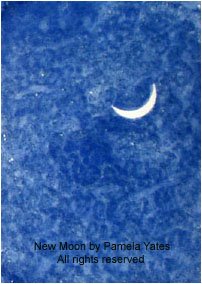
When Grandmother Moon was last approaching her fullness, the peak of her cycle, I made a note in my sketchbook to acknowledge her on this blog. New Moon 05/04
Her strong soft light keeps the trees aglow at night. I haven't painted a Full Moon image recently, however, I am reminded of two New Moon paintings I sold this year. This image is one of them or view it on my web site where I intend to write a story about the process involved in creating this texturally rich painting, as well as stories about Grandmother Moon.

These New Moon paintings were both full of creative freedom and rule-breaking. I took very deliberate steps to break rules about the "right" way to create a finished watercolor painting. It's considered purely awful in traditional watercolor company to despoil the surface of the paper support. It's true that in a traditional watercolor, scuffed paper could ruin the whole painting. But to achieve the result I envisioned for my painting, I needed to dig deep and work that surface, rough it up until I could sense the depth of inky sky, mystery, darkness and black holes up there in the great big beyond. (Incidentally you need a robust and burly watercolor paper that's tough enough for this kind of manipulation. A 200lb rag paper or heavier and a type that won't fall apart on you. Be prepared to experiment and throw a few cuttings away.) Artists have to break rules to get our creative work done. We earn the right to do that as creators and artists. If we get our hands crusty with the medium we work with, we then earned the right to break the rules. Don't let anybody tell you different. Guidelines are better than rules. Guidelines are exactly that - guides to a certain practice for a reason. A rule is a rigid thing. When it tramples the creative spirit and dampens creative drive, it's a poor rule. It's true that rules are made for a reason and can be valid and important but to follow a rule just because someone said "you can't do that, it ain't right" is a poor reason on it's own. As an artist, think for yourself, make your own rules. It's the only way to deepen your creative freedom and to express your unique creative voice.

Happy creating, see you at the Cafe!

Sunday, March 11, 2007

Recommended reading #1

Before I head out for a creative working session it's a good time to begin the Creativity Book List I thought I might compile here at Creative Circle Cafe. I'll revisit this list to with additional recommendations later. So, let's get off to a tremendously good start with three books I've listed at the bottom of this post. I hope they'll be a great resources for you and, for coaches and teachers, a helpful resource for your clients and students. For that special creative person in your life it's a post you can print and wrap as a gift - and buy them a book or two from the list! The material covered in these books relate to real-life artmaking and all aspects of living and nurturing a creative life.

Here's the first of the books I recommend on artmaking and creativity:

Art & Fear, Observations On The Perils (and Rewards) of Artmaking by David Bayles and Ted Orland
Art & Soul, Notes on Creating by Audry Flack
Fearless Creating by Eric Maisel, Ph.D.

Blessings and happy creating!

Sunday, February 4, 2007

Abstraction and "authenticity muscle"

Did you ever stop to think about how much of life comes to us via abstraction? I was thinking about this today as my artist's bio passed in front of my eyes and I caught sight of the words "figurative abstract." So I started thinking about abstraction and how our worldview is partly drawn from emotional, spiritual, mental abstraction. The personal smoke and mirrors we use, often unconsciously. When I consider what it means to create meaningful work as a painter (I spend a lot of time working and thinking around this topic in my creative work and as a creativity coach with my clients) it seems to me that much of our worldview is (an) abstraction. Today I just want to suggest that perhaps if we aren't alert to this, if we don't accept this awareness of abstractions which are alive and well in daily life, we're condemned to think in linear terms about almost everything. We will think everything is flat, black and white, linear and know-able.

I'm not an intellectual so please feel free to poke holes in my theory but it seems to me that acknowledging the abstraction in life, in our sacred personal day-by-day life, frees us from believing that everything is visible with our physical eyes. If we are alert to being romanced by abstractions, alert to being enticed away from authentic living by distractions, we will exercise our "authenticity muscle" and be free to embrace and see with the eyes of the heart while living in a mostly linear world (cell phones, television, computer, bills). If we choose carefully which abstractions we apply and accept as part of our worldview then we are free to embrace and enrich our lives by deliberately tuning into mystical, sacred, creative action. I hope you will be deliberate about selecting abstractions today and celebrate your mystical, sacred, creative Self.

I wish you all a good week and challenge you to embrace and exercise your "authenticity muscle!"

Blessings,
Pamela

Friday, January 12, 2007

Roiling creativity

Creativity is an everyday occurrence. It's happening all around us. We're enfolded every moment in the roiling wash of a blossoming universe. Being actively engaged in the creative process of our lives, influences the way we listen to and hear others, as well as how we reveal ourselves. Listen to your heart.

Step 1: Engage
Ste[ 2: Create
Step 3: Repeat !

Sunday, December 10, 2006

Floorboards

What is that quote about "the longest journey begins with a single step"? This is particularly meaningful in my musings today about my work as a creativity coach and the challenges artists face in their work. Oftentimes the hardest step is either the first one out of bed onto the floorboards or else it is taking the steps necessary to go from point A (where the artist is now) to point B (the artists workspace - studio - desk - piano - kitchen table - a workshop - whatever).

There's no avoiding make the journey from A to B if we intend to be active, producing artists.

If you get stuck moving from A to B and you can see that this continues to diminish the quality of your creative work, your self esteem as well as your productivity then it is your job as a professional to target this behavior for serious but compassionate remedial work. It will be worth your time and effort to do as a gift for yourself and for your creative work.

Moving from A to B is fertile ground because it's the physical, emotional and spiritual move into your creative space, but unless we actually arrive at B ready to do our creative work, then we may find we're unable to move towards the next sacred creative place where our work requires us to go. Give yourself the gift of enlightenment about the journey from A to B. My post Recommended Reading List #1 provides resources that if applied with love, determination and regular practice will lift from your creative shoulders the weight of being barred from arriving at your creative work-space and the work itself. I hope you'll find something helpful in this suggested reading. There are good creativity coaching who can help, too, if you're interested in other tools for creative development.

Happy journeys from A to B and beyond!

Friday, October 27, 2006

Limited edition prints

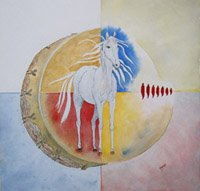
There's always more waiting to happen in our creative lives. If we listen to our hearts and follow that voice, our creative movement will be meaningful and important to us. A source of joy in my creative life is the announcement of a new Limited Edition print of the painting, Honoring the Horse Nation. The drum represents a drum group who are singing an honoring song for the Horse Nation and the white horse represents all horses. The drum beat is the heart beat of Mother Earth. This archival quality reproduction is the same size as the original watercolor painting. For more information click my Home Page link on the main page of this blog.
Honoring the Horse Nation by Pamela Yates

Create!

Friday, October 20, 2006

Nurturing dreams

Yesterday (Saturday, August 19, 2006) I had the great privilege of attending the graduation ceremony for my husband, Richard Watson, who had completed school to become a licensed massage therapist and therapeutic bodyworker. The group of adults in the graduation ceremony had all recently completed their programs and are now officially joining the ranks of professional massage therapists and bodyworkers. We heard stories from some graduating students and from teachers and faculty. I was very moved and inspired by their intent to serve others, to help people heal themselves, and provide compassion and guidance to others on that journey. Some of these graduating students had experienced a good deal of hardship and performed amazing feats of self-discipline to achieve this dream of graduating from their bodywork program. Many of them cared for their families, communities and others while continuing with school. Some of them had to overcome their own negative self-talk, as well as allaying the doubts and fears of other people. But they made it through. They held fast to their dream and they kept moving forward, one class at a time. What a wonderful reminder of the many such kind and good people amongst us.

As an artist and creativity coach for other artists, I've learned this negative self-talk habit is a common trait amongst artists - as well as in the larger community. Not to say that other people don't experience this habit but, research and anecdotal experiences indicate it's especially common in artists and actively creative people. Many of my artist colleagues and friends express a real need for reminders of the grace and kindness in the world because they consciously give attention to areas that are difficult or challenging to think about, as they determine where the inspiration for their next work should be.

Well, yesterday's graduation ceremony was one of those times when, unbidden, an unexpected depth of grace and beauty slipped into my life and I was fully awake to the beauty of it. Thank you to my husband, Richard, and all those graduates for that. What a gift!

Nurture your dreams!